
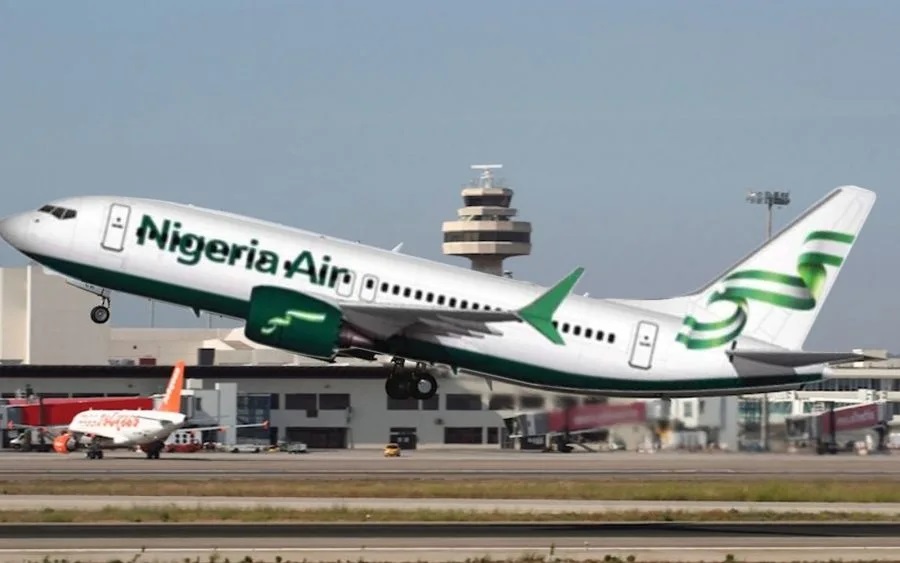
Nigeria’s Aviation Minister, Hadi Sirika, has hinted that the controversial national carrier, Nigeria Air, will commence operation before the swearing-in of a new administration on 29 May.
The minister disclosed this at the ongoing National Aviation Stakeholders Forum 2023 in Abuja on Thursday.
“Operation of local and international flights will commence soon. Before the end of this administration, before May 29, we will fly,” Mr Sirika said.
“Negotiation meetings with the Ethiopian Airlines Group Consortium and the Federal Government of Nigeria is ongoing. Next step: Federal Executive Council approval of the Full Business Case.”
The minister emphasised that the benefits Nigeria stands to derive from the establishment of the national carrier include reduced capital flight from Nigeria, maximisation of the benefit of Bilateral Aviation Safety Agreement (BASA) and Single African Air Transport Market (SAATM) and development of an aviation hub.
Also, Mr Sirika said the National carrier will contribute to the country’s GDP, facilitate hospitality and tourism, facilitate growth and development of the Nigerian agricultural sector, and create jobs around the Agro-Cargo Terminals.Many Nigerians have criticised the Muhammadu Buhari administration for seeking to start a new national carrier after the former national carrier, Nigeria Airways, collapsed largely due to corruption.
The government, which has less than two months in office, has, however, said the new carrier would only be partly government-owned and would be managed by a private partner.However, some local airlines in Nigeria have sued the federal government, asking the court to stop the new national carrier as it would get unfair advantages over other airlines in the country.In November last year, a Federal High Court in Lagos issued an order of interim injunction restraining the Nigerian government from proceeding with the establishment of the national carrier.
In February, Mr Sirika said he was not aware of any court injunction barring the commencement of Nigeria Air and that it would commence operations soon.
Meanwhile, in recent months, Nigeria’s foreign exchange crisis has worsened amidst depletion of its foreign reserves.
This has significantly impacted the aviation sector. While foreign airlines are experiencing difficulty repatriating their trapped funds, domestic and international airlines are also faced with skyrocketing aviation fuel prices.
Two weeks ago, the International Air Transport Association (IATA), the top global trade association of airlines, appealed to the Nigerian government to allow international airlines to repatriate their funds trapped in the country.
It said the amount airlines have been unable to repatriate from the country rose to $743.7 million in January from $662 million it stood last December.
